By the end of this module
- Trace audio and metadata from Pro Tools to final render.
- Distinguish beds, objects, groups, and re-renders.
- Describe what binaural monitoring can and cannot predict.
Core knowledge
Principles before controls
Atmos separates audio from some playback decisions
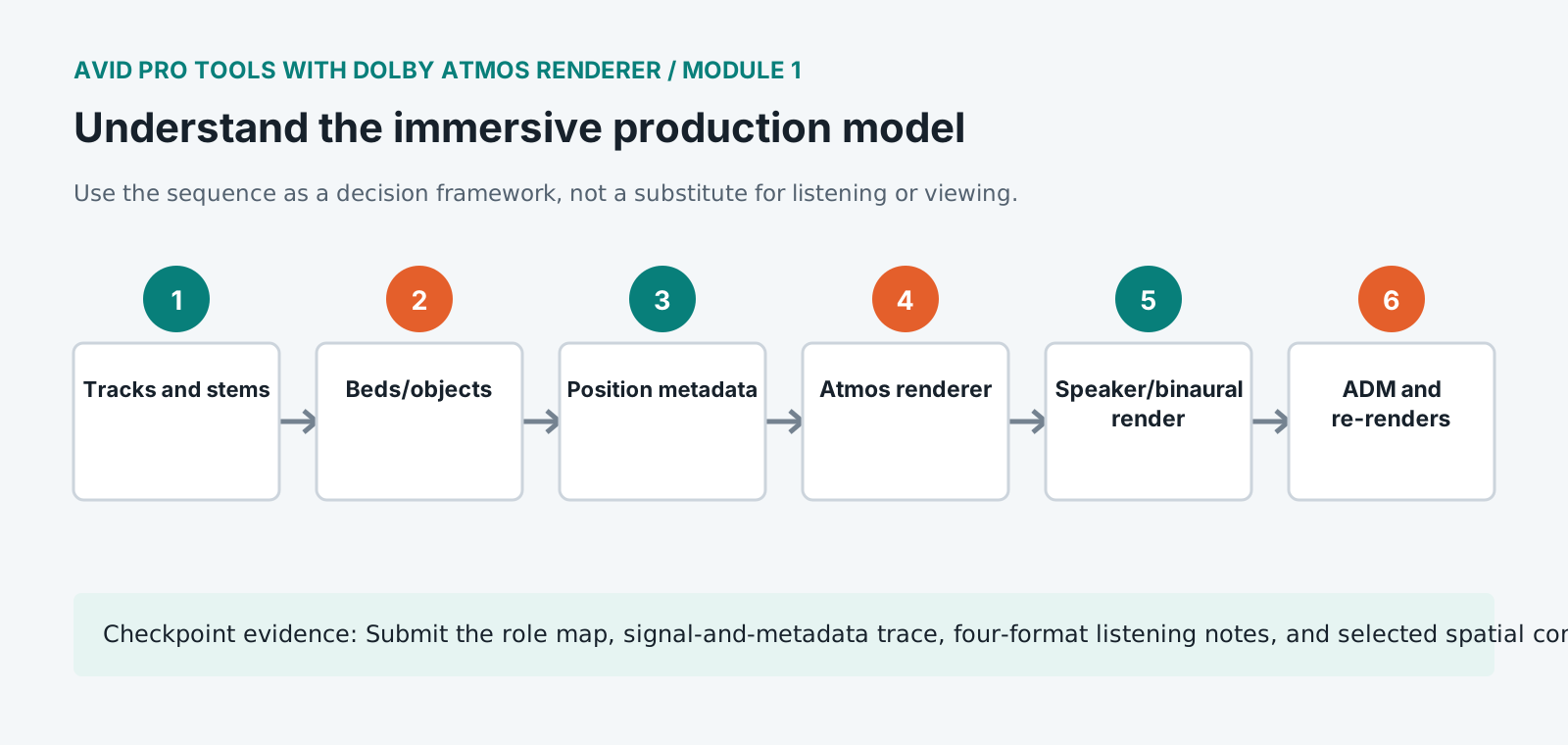
Objects carry audio plus position metadata, while the renderer adapts playback to the available speaker or headphone format.
Beds and objects solve different problems
Beds provide stable channel-based foundations. Objects allow independent position and metadata. Neither is automatically more immersive.
The mix room is one interpretation
A 7.1.4 room, a soundbar, stereo speakers, and binaural headphones render the same master differently. Translation is part of authorship.
Immersion requires hierarchy
Width and movement are useful only when focus, groove, lyrics, contrast, and emotional progression remain intelligible.
Guided build / approximately 90-120 minutes
Build it in the application
- 1
Listen to the supplied stereo reference and map foreground, support, pulse, ambience, and transition roles.
- 2
Play the Atmos demonstration through 7.1.4, binaural, stereo, and mono paths without changing level. Record differences before seeing the session.
- 3
Trace one bed signal and one object signal through track, bus, renderer input, metadata, speaker output, and re-render.
- 4
Create a paper plan assigning each stem a default role: anchor, width, depth, height, movement, or environment.
- 5
Identify elements that should remain stable across the song and those that can change spatial role between sections.
- 6
Compare static envelopment, localized placement, and motion using the same source at matched level.
- 7
Write three translation risks for the proposed plan and one check that can reveal each risk.
- 8
Complete a vocabulary map connecting bed, object, metadata, renderer, ADM, binaural mode, trim, downmix, and re-render.
Independent challenge / 45-60 minutes
Prove the principle
Design two spatial concepts for the same chorus: audience-facing stage and inside-the-production perspective. Explain focus, translation, and fatigue tradeoffs.
Portfolio checkpoint
Evidence to retain
Submit the role map, signal-and-metadata trace, four-format listening notes, and selected spatial concept.
Store this evidence in 01_ADMIN/checkpoints/module-1 and include it in the final decision log.
Failure modes
Diagnose before retrying
A student equates height with quality
Return to musical hierarchy and compare a focused static placement against constant movement at matched level.
Binaural and speakers disagree
Treat them as different renders. Inspect object positions, binaural modes, decorrelation, phase, and room-dependent cues.
An object appears to vanish in a downmix
Check level, masking, phase, divergence, routing, and the selected re-render rather than assuming metadata failed.
Working vocabulary
Terms you must be able to explain
- bed
- A channel-based multichannel path used as a stable component of an Atmos mix.
- object
- Audio accompanied by positional and rendering metadata.
- renderer
- The system that combines audio and metadata for a selected playback layout or master.
- re-render
- A channel-based output derived from an Atmos mix, such as stereo or 5.1.
Primary sources
Verify current behavior
Lesson reviewed 2026-07-13. Verify menus and shortcuts against the lab release.
Failure in practice
Where this goes wrong
Beds and objects are different tools rather than a quality hierarchy. A bed is a fixed channel layout suiting sustained material and ambience, and an object carries its own position and moves. Treating everything as an object is a common early mistake, and it consumes the available object count without improving the result.
The immersive mix is not the stereo mix with reverb moved backwards. Elements that worked in front of a listener frequently need rebalancing once they surround, and material spread widely can lose the focus it had. Expect to make different decisions rather than to translate existing ones.
Listen to a reference immersive mix you admire before starting. Understanding what the format sounds like in competent hands sets an expectation that a specification document cannot.