 Image credit & licence
At a Glance
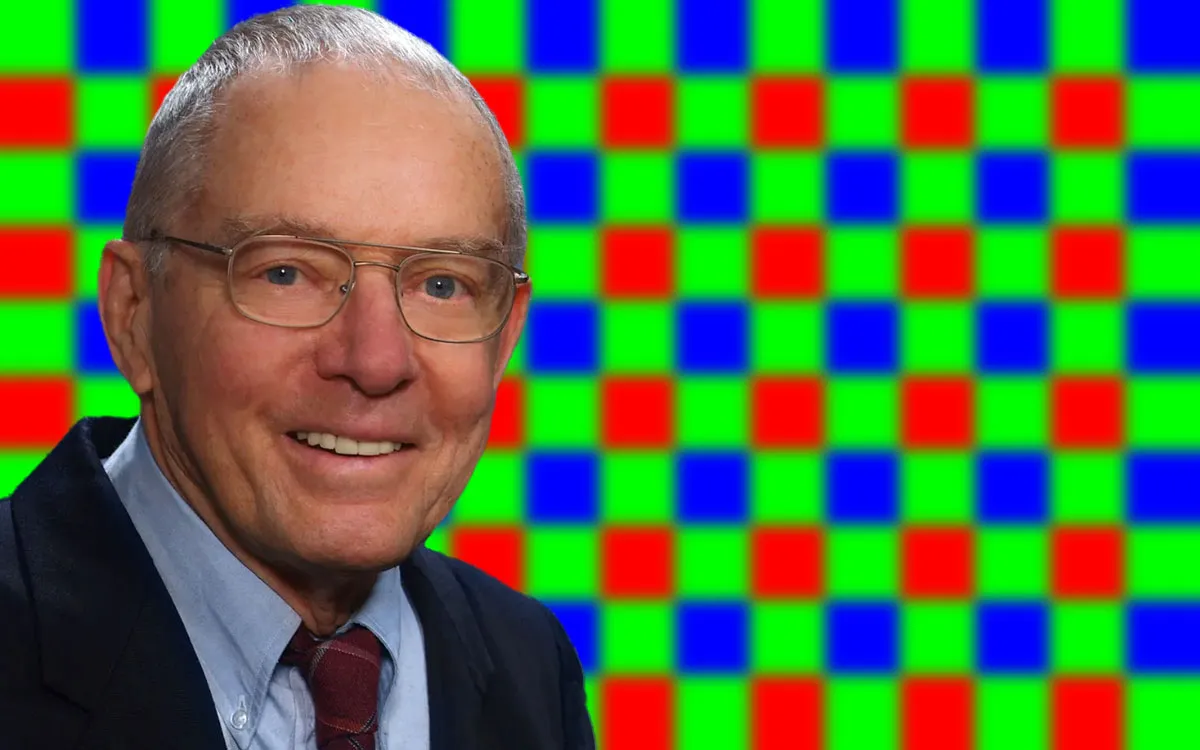
Bryce Edward Bayer (1929-2012) devised the Bayer filter at Kodak in 1976: a mosaic of red, green and blue filters over a monochrome sensor, with twice as many green cells as red or blue. Essentially every colour digital camera sensor uses it or a derivative.
- Lived: 1929-2012, United States
- Anchor year: 1976, the Bayer filter
- Strand: overlooked, in every digital camera
Career
The problem as it stood
An image sensor measures light intensity and knows nothing about colour. Getting three colour values per location seemed to need three sensors and a beam splitter, the Technicolor solution, expensive and bulky, or three sequential exposures, useless for moving subjects.
What he actually did
Bayer put a mosaic of colour filters directly over the sensor, one colour per photosite, in a repeating pattern with twice as many green as red or blue. The missing two values at each site are reconstructed from neighbours.
How it worked
Human vision resolves luminance detail far better than colour detail, and luminance perception is dominated by the green part of the spectrum. Weighting the mosaic toward green therefore samples most finely exactly where the eye is most sensitive to detail. The reconstruction, demosaicing, exploits the same asymmetry.
What it made possible
Single-sensor colour cameras: every consumer digital camera, phone, camcorder and most professional cinema cameras. It is why raw files exist as a distinct format, since raw data is the undemosaiced mosaic.
What happened to him
He spent his career at Kodak in imaging science and died in 2012. The pattern carries his name, which is unusually good attribution for this corpus, though very few of the billions of people using it daily know it.
Where the credit landed
Bayer's name survives on the pattern, so attribution held better here than in most of this wave. The idea also rests on the same perceptual asymmetry, luminance detail matters more than chrominance detail, that underlies colour subsampling in video and the chroma handling in JPEG and MPEG. It recurs throughout the corpus because it is a fact about eyes, not about engineering.
Known For
- Twice as many green cells because luminance perception is dominated by green.
- Raw files are the undemosaiced mosaic: that is what makes them raw.
- The same luminance-over-chrominance asymmetry drives chroma subsampling in video.
Knowledge Base
What You'll Learn
One filter pattern, resting on one fact about human vision.
The same asymmetry, everywhere
Human vision resolves brightness detail far better than colour detail. The Bayer pattern samples green most finely for that reason. Video chroma subsampling, 4:2:2 or 4:2:0. Discards colour resolution for the same reason and is why chroma keying against a heavily subsampled source produces ragged edges. JPEG subsamples chroma too. One property of the eye, exploited independently at three different points in the chain.
Where This Fits
Bayer's filter sits on the sensor at the capture end of the chain followed in A History of Broadcast Technology.
FAQ
Q: What is a Bayer filter?
A: A mosaic of red, green and blue filters over a monochrome image sensor, with twice as many green cells as red or blue. Each photosite measures one colour, and the other two are reconstructed from neighbours by demosaicing.
Q: Why twice as many green?
A: Because human luminance perception is dominated by the green part of the spectrum, and the eye resolves brightness detail far better than colour detail. Sampling green most finely puts the resolution where it is most visible.
Vocabulary
Colour filter array. A grid of coloured filters laid over a sensor so each cell records one colour only. Necessary because a bare sensor measures brightness alone and cannot distinguish wavelengths on its own.
Demosaicing. The calculation that turns a sensor's single-colour-per-cell readings into a full colour image, estimating the two missing values at every position from the neighbours around it. Every digital photograph passes through it.
Luminance. The brightness component of an image, separate from its colour. Human vision resolves detail in luminance far more finely than in colour, which is why sensor and codec designs both spend more of their resources on it.
Spatial resolution. How much fine detail an imaging system can distinguish. Limited by the sensor's cell spacing as well as by the lens, so the arrangement of a filter array directly affects the sharpness of the result.
Sources
The patent was checked against the record. Checked 20 August 2026.
- US Patent 3,971,065, Color Imaging Array. Bayer as sole named inventor, assigned to Eastman Kodak. Filed 5 March 1975 and granted 20 July 1976, which is the anchor year above. The claims describe the interlaid pattern of luminance and chrominance elements that this page calls twice as many green cells.
Translate this page
- Español
- 简体中文
- हिन्दी
- العربية
- Português
- Français
- Deutsch
- 日本語
- Русский
- Bahasa Indonesia
- 한국어
- Italiano
- Türkçe
- Tiếng Việt
- Polski
- Nederlands
Machine translation provided by Google Translate, on Google’s servers. We do not check these translations and they will get technical terms wrong. The English page is the authoritative one. Following a link sends this page’s address to Google. Your browser may also offer to translate this page itself, which keeps the request on your device.