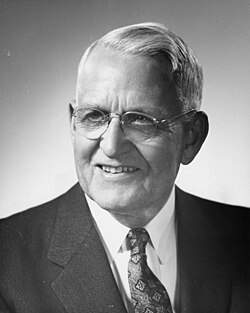
 Archival scan, shown at its original size. Image credit & licence
At a Glance
Harvey Fletcher (1884-1981) established psychoacoustics as an engineering discipline at Bell Labs. His work on critical bands, equal-loudness contours and auditory masking quantified what human hearing actually does, and that data is the direct foundation of every perceptual audio codec: MP3, AAC and their successors.
- Lived: 1884-1981, United States
- Anchor year: 1933, stereophonic demonstration and the psychoacoustic work
- Strand: overlooked, a Bell Labs name behind every codec
Career
The problem as it stood
Telephone engineers needed to know how good a transmission had to be. That is not an acoustics question but a perception question: how much distortion, noise and bandwidth restriction can a listener tolerate before speech becomes unintelligible or unpleasant? Nobody had measured it.
What he actually did
Fletcher ran systematic listening experiments with calibrated equipment, producing the equal-loudness contours (with Munson) showing how perceived loudness varies with frequency, the concept of critical bands, and quantified masking: how a loud sound renders a nearby quieter one inaudible. He also led the 1933 stereophonic demonstrations transmitting a live orchestra from Philadelphia to Washington.
How it worked
The ear behaves roughly as a bank of overlapping filters. Within one critical band, a loud component masks quieter ones. Across bands, much less so. Loudness perception varies strongly with frequency, which is why quiet music seems to lose its bass. All of this is measurable, repeatable and expressible as curves an engineer can design against.
What it made possible
Directly: telephone system design, hearing aids and audiometry. Indirectly and enormously: perceptual coding. An MP3 encoder works by computing what is masked and discarding it, which requires exactly Fletcher's masking data. Every streaming service depends on this.
What happened to him
He directed physical research at Bell Labs, later returned to academia at Brigham Young University, and lived to 97. He is well known within acoustics and essentially unknown outside it.
Where the credit landed
The Fletcher-Munson curves are among the few things in this corpus that carry their authors' names into everyday professional use: audio engineers say "Fletcher-Munson" routinely without knowing who Fletcher was. The larger contribution, making hearing a measurable engineering input, is credited to Bell Labs as an institution.
Known For
- Masking is why lossy compression works at all.
- Equal-loudness contours explain why quiet mixes seem to lose bass.
- Perceptual coding is Fletcher's data turned into an algorithm.
Knowledge Base
What You'll Learn
Every codec in this corpus is an argument about what you will not notice.
From critical bands to MP3
A perceptual encoder splits the signal into frequency bands, computes a masking threshold for each from a psychoacoustic model, and allocates bits only where the ear will notice, discarding whatever falls below threshold. That model is a direct descendant of Fletcher's measurements. The line runs from Bell Labs listening tests in the 1930s through Manfred Schroeder's work on masking to Brandenburg's Fraunhofer team and MPEG standardisation.
Where This Fits
Fletcher's hearing data explains what the listener at the end of the chain perceives, the chain set out in A History of Broadcast Technology.
FAQ
Q: What are the Fletcher-Munson curves?
A: Equal-loudness contours showing how the perceived loudness of a tone varies with frequency at different sound pressure levels. They explain why bass seems to disappear at low listening volumes.
Q: What does psychoacoustics have to do with MP3?
A: Everything. Perceptual codecs discard sound that masking makes inaudible, and the masking models they use descend directly from Fletcher's measurements of how human hearing behaves.
Vocabulary
Psychoacoustics. The study of how hearing responds to sound, as distinct from what a microphone measures. Provides the data that perceptual audio codecs use to decide what can be discarded.
Critical band. The range of frequencies the ear treats as a single unit when judging loudness and masking. Explains why two tones close together interact differently from two far apart.
Equal-loudness contour. A curve showing the sound pressure needed at each frequency for a tone to be perceived as equally loud. Explains why hearing is far less sensitive to low frequencies at quiet levels.
Masking. The effect where a louder sound makes a quieter one nearby in frequency inaudible. The property perceptual codecs exploit, since a masked sound need not be stored at all.
Sources
The paper was checked against its publication record. Checked 20 August 2026.
- Harvey Fletcher and W. A. Munson, Loudness, Its Definition, Measurement and Calculation. The Journal of the Acoustical Society of America, volume 5, issue 2, pages 82 to 108, October 1933, the anchor year above. This is where the equal loudness contours come from, and the record names W. A. Munson alongside Fletcher, which is why they are known as the Fletcher-Munson curves.
Translate this page
- Español
- 简体中文
- हिन्दी
- العربية
- Português
- Français
- Deutsch
- 日本語
- Русский
- Bahasa Indonesia
- 한국어
- Italiano
- Türkçe
- Tiếng Việt
- Polski
- Nederlands
Machine translation provided by Google Translate, on Google’s servers. We do not check these translations and they will get technical terms wrong. The English page is the authoritative one. Following a link sends this page’s address to Google. Your browser may also offer to translate this page itself, which keeps the request on your device.