 Image credit & licence
At a Glance
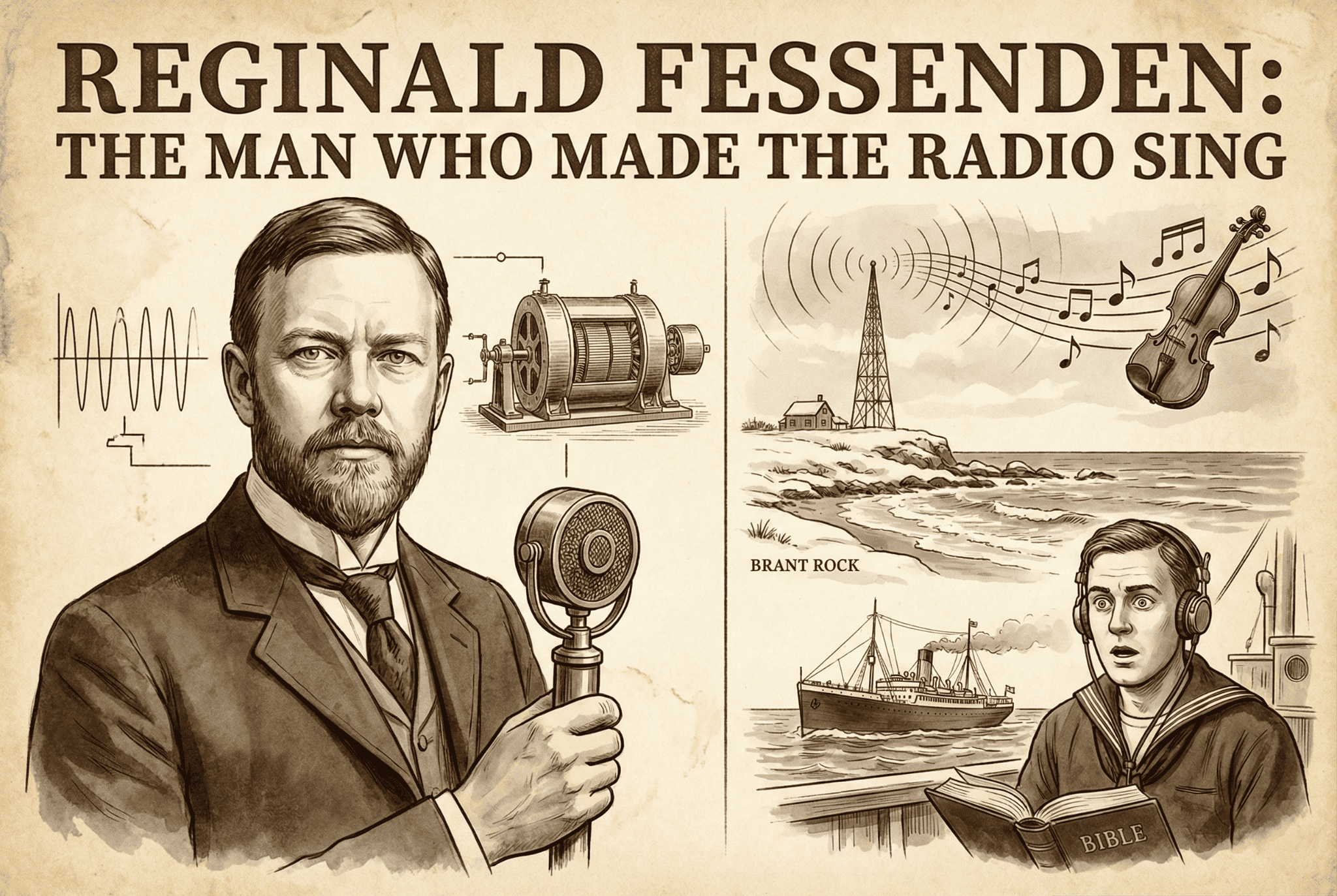
Reginald Aubrey Fessenden (1866-1932) established that voice could be transmitted by amplitude modulating a continuous radio wave, rather than by the interrupted spark that carried telegraphy. He commissioned the Alexanderson alternator to generate such a wave. The famous Christmas Eve 1906 broadcast rests on a single source: his own account, written in 1932.
- Lived: 1866-1932, Canada, worked in the United States
- Anchor year: 1906, continuous-wave voice transmission
- Strand: canon, with one much-repeated undocumented event
Career
The problem as it stood
A spark transmitter produces a damped burst of noise across a wide band. It can be turned on and off to send Morse and it cannot carry a waveform. Voice needs a steady carrier whose amplitude can be varied smoothly.
What he actually did
Fessenden argued for and pursued the continuous wave, commissioning Ernst Alexanderson at General Electric to build a high-frequency alternator producing a steady radio-frequency output, and modulating it with a carbon microphone in the antenna circuit.
How it worked
A continuous carrier of constant frequency has its amplitude varied in step with the audio. The receiver rectifies the carrier and recovers the envelope, which is the sound. This is AM, and it remains how AM broadcasting works. Putting a carbon microphone directly in the antenna circuit was crude but functional.
What it made possible
Radio as a medium for speech and music rather than code, and therefore broadcasting. The alternator he prompted also became the basis for high-power long-wave transmission before valve transmitters matured.
What happened to him
He held hundreds of patents, fell out with his financial backers, and litigated for years. He also did significant work on echo sounding and sonar. He died in Bermuda in 1932.
Where the credit landed
Fessenden is documented as an early pioneer of voice transmission by radio. The specific Christmas Eve 1906 broadcast from Brant Rock, in which ships at sea are said to have heard him play the violin and read from the Bible, rests on a single source, a letter he wrote in 1932, with no independent contemporaneous corroboration found. The wider achievement is solid. That particular famous evening is not documented.
Known For
- Spark cannot carry a waveform. A continuous wave can.
- The Christmas Eve 1906 broadcast rests on Fessenden's own 1932 letter alone.
- He commissioned the Alexanderson alternator rather than building it.
Knowledge Base
What You'll Learn
The step from code to voice is the step from telegraphy to broadcasting.
Why the continuous wave was the hard part
Generating a steady, high-frequency oscillation at useful power was genuinely difficult before valve transmitters. Spark was easy and useless for voice. The Alexanderson alternator solved it mechanically, an enormous machine spinning fast enough to generate radio frequencies directly, until de Forest's grid made electronic oscillators practical and the alternators became obsolete.
Where This Fits
Voice on a continuous wave is the start of radio broadcasting, the transmission link at the centre of A History of Broadcast Technology.
FAQ
Q: Did Fessenden make the first radio broadcast?
A: He is documented as an early pioneer of voice transmission by radio. The famous Christmas Eve 1906 broadcast is attested only by his own account written in 1932, with no independent contemporaneous corroboration.
Q: What is amplitude modulation?
A: Varying the strength of a steady radio carrier in step with an audio signal. The receiver recovers the audio by rectifying the carrier and following its envelope.
Vocabulary
Carrier wave. A steady radio wave whose properties are varied to carry information. The signal a receiver tunes to, with the actual content ridden on top of it as variation.
Heterodyne. Mixing an incoming radio signal with a locally generated one to produce a lower frequency that is easier to amplify and filter. The principle behind almost every radio receiver since.
Modulation. Varying some property of a carrier wave in step with the information being sent. Amplitude, frequency and phase are the three properties available, each producing a different transmission scheme.
Demodulation. Recovering the original information from a modulated carrier at the receiving end. Has to reverse whatever the transmitter did, which is why transmitter and receiver must agree on the scheme.
Sources
The patent was checked against the record. Checked 20 August 2026.
- US Patent 706,740, Wireless Signaling. Fessenden as sole named inventor with no corporate assignee, so he held it himself. Filed 28 September 1901 and granted 12 August 1902. The specification describes the production of electrical beats analogous to sound beats, which is the principle later called heterodyne. It is documentary in a way the Christmas Eve 1906 broadcast discussed above is not.
Translate this page
- Español
- 简体中文
- हिन्दी
- العربية
- Português
- Français
- Deutsch
- 日本語
- Русский
- Bahasa Indonesia
- 한국어
- Italiano
- Türkçe
- Tiếng Việt
- Polski
- Nederlands
Machine translation provided by Google Translate, on Google’s servers. We do not check these translations and they will get technical terms wrong. The English page is the authoritative one. Following a link sends this page’s address to Google. Your browser may also offer to translate this page itself, which keeps the request on your device.