By the end of this module
- Explain source, filter, amplifier, envelope, and modulation stages.
- Choose an appropriate warp mode and correct timing without unnecessary damage.
- Build a playable Instrument Rack with meaningful macros.
Core knowledge
Principles before controls
Synthesis begins with source and time
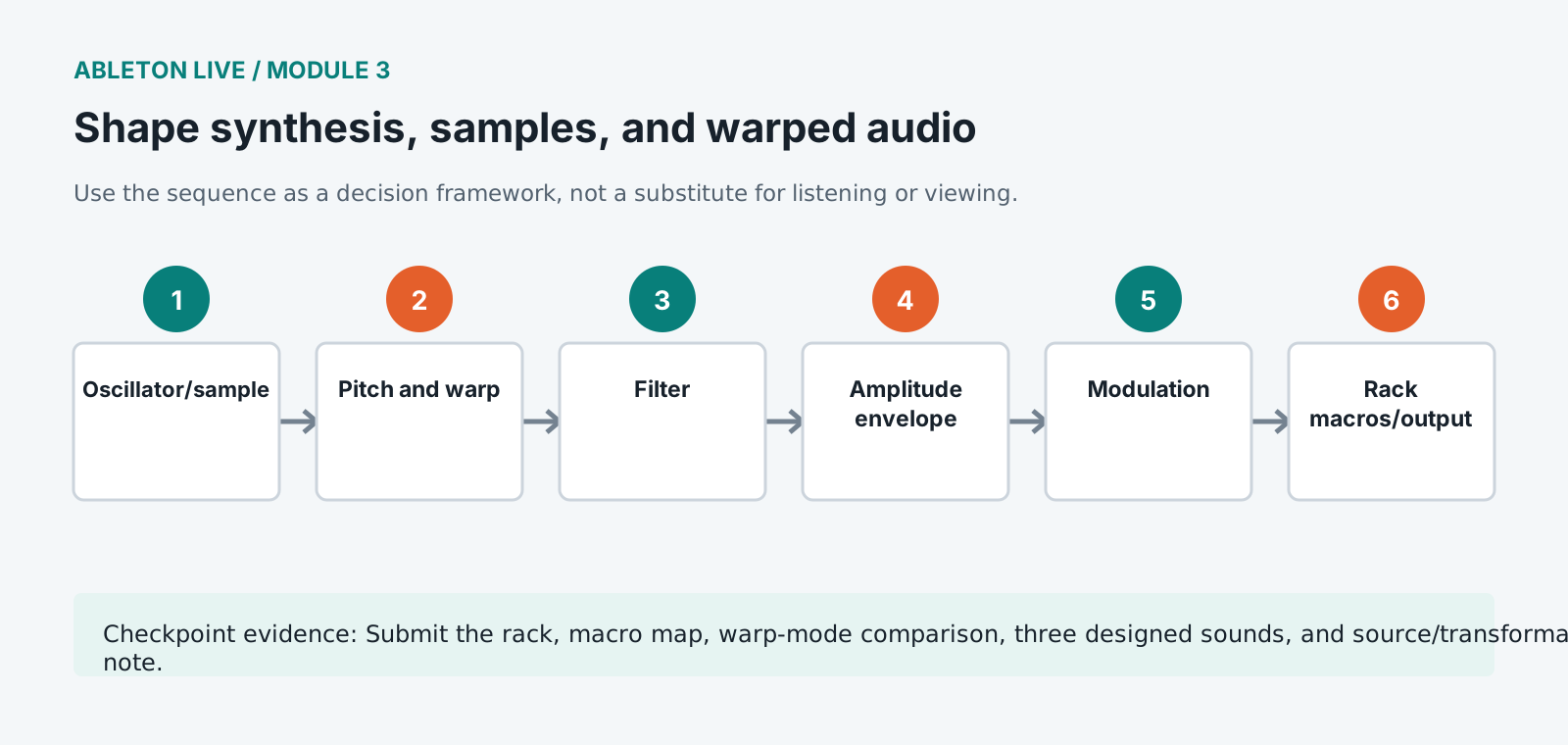
Oscillator or sample spectrum, amplitude envelope, filter envelope, and modulation define how a sound occupies pitch, duration, and attention.
Warping changes the time relationship
Markers align source events to project time. Warp mode determines how intermediate audio is reconstructed.
Modulation should expose structure
LFOs, envelopes, velocity, key tracking, and macro changes are useful when they reinforce rhythm, phrase, or performance.
Racks encode playable decisions
Macros should control perceptually meaningful ranges and combinations rather than expose arbitrary device parameters.
Guided build / approximately 90-120 minutes
Build it in the application
- 1
Create a simple bass from one oscillator or source and shape its amplitude envelope around the rhythmic role.
- 2
Use filter cutoff, resonance, envelope amount, and key tracking to balance articulation and stable pitch weight.
- 3
Add one controlled modulation source and set its range so the sound remains usable across the project.
- 4
Create a contrasting harmonic or lead sound using a different source and envelope profile.
- 5
Import the licensed field recording, set the correct original tempo or transient anchors, and compare Beats, Tones, Texture, Re-Pitch, and Complex modes.
- 6
Place only the warp markers needed to correct or transform the selected passage and inspect transients after every move.
- 7
Build an Instrument or Audio Effect Rack with four macros named by perceptual result, each limited to safe ranges.
- 8
Map velocity or another performance dimension to at least one timbral parameter and record a short expressive part.
- 9
Freeze, flatten only a duplicate, or bounce the designed sounds while preserving an editable source chain.
Independent challenge / 45-60 minutes
Prove the principle
Create bass, lead, and atmosphere from one supplied field recording without external plugins. Preserve a documented editable chain for each.
Portfolio checkpoint
Evidence to retain
Submit the rack, macro map, warp-mode comparison, three designed sounds, and source/transformation rights note.
Store this evidence in 01_ADMIN/checkpoints/module-3 and include it in the final decision log.
Failure modes
Diagnose before retrying
Warped transients smear
Use fewer markers, align true transients, select a suitable mode, and avoid extreme local stretching.
Bass changes level across notes
Review filter resonance, key tracking, oscillator phase behavior, envelope, velocity mapping, and monitoring room modes.
Macros produce unusable extremes
Reduce mapped ranges, invert or scale relationships deliberately, and test every combination at controller limits.
Working vocabulary
Terms you must be able to explain
- envelope
- A time-varying shape controlling amplitude, filter, pitch, or another parameter.
- warp marker
- An anchor mapping a source time position to Live's musical timeline.
- macro
- A rack control mapped to one or more parameters over defined ranges.
- key tracking
- Parameter change related to played pitch, often used to keep timbre consistent across registers.
Primary sources
Verify current behavior
Lesson reviewed 2026-07-13. Verify menus and shortcuts against the lab release.
Failure in practice
Where this goes wrong
Warp mode is chosen by material, not by preference. Modes optimised for rhythmic content preserve transients and smear sustained sound, and modes built for texture do the reverse. Applying one mode across a whole project guarantees that some of the material is being handled by the wrong algorithm.
Check the transient markers before stretching anything substantially. Automatic detection puts them approximately right and gets confused by soft attacks and dense material, and a marker in the wrong place produces artefacts that sound like a fault in the audio rather than a setting you chose.
Audition every warped clip at its original tempo before committing. Artefacts introduced by stretching are easiest to hear against the unstretched source, and a clip that survives a large tempo change usually needed a different warp mode rather than a better setting.