Student production lifecycle
How a Television Series Is Made
Follow a recurring television idea from pitch and series bible through a feasible micro-pilot, post-production, accessibility, and delivery.
Completed outcome
Micro-pilot and series bible
A five-to-eight-minute micro-pilot or proof-of-concept scene plus a compact series bible.
What students will learn
- Compare scripted, factual, studio, and magazine series formats.
- Develop a repeatable series promise with research, contributors, format, and audience evidence.
- Move from outline and script or treatment through schedule, production, post, access, QC, and packaging.
- Explain how individual roles connect to a television series lifecycle.
Equipment and prerequisites
- Tier A: phone/tablet, headphones, basic editor, classroom space.
- Tier B: two cameras, tripod, portable audio, lights, editing computers.
- Tier C: studio, multi-camera tools, graphics, shared storage, and production support.
- Complete Production Readiness orientation.
- Teacher-approved topic, contributors, locations, and publication boundary.
- Use fictional or rights-cleared source material unless the school has approved otherwise.
Required once before any student production course
Production Readiness: Make Media Safely and Hand It Off
A shared orientation for high-school students covering audience, consent, rights, safety, accessibility, roles, files, versions, and handoff before a production begins.
- Translate an idea into an audience promise and observable success criteria.
- Identify consent, privacy, rights, safety, accessibility, and publication decisions before recording.
- Create a folder, naming, version, backup, and handoff system another student can navigate.
- Participate in a respectful crew with a clear role, communication path, and stop-work authority.
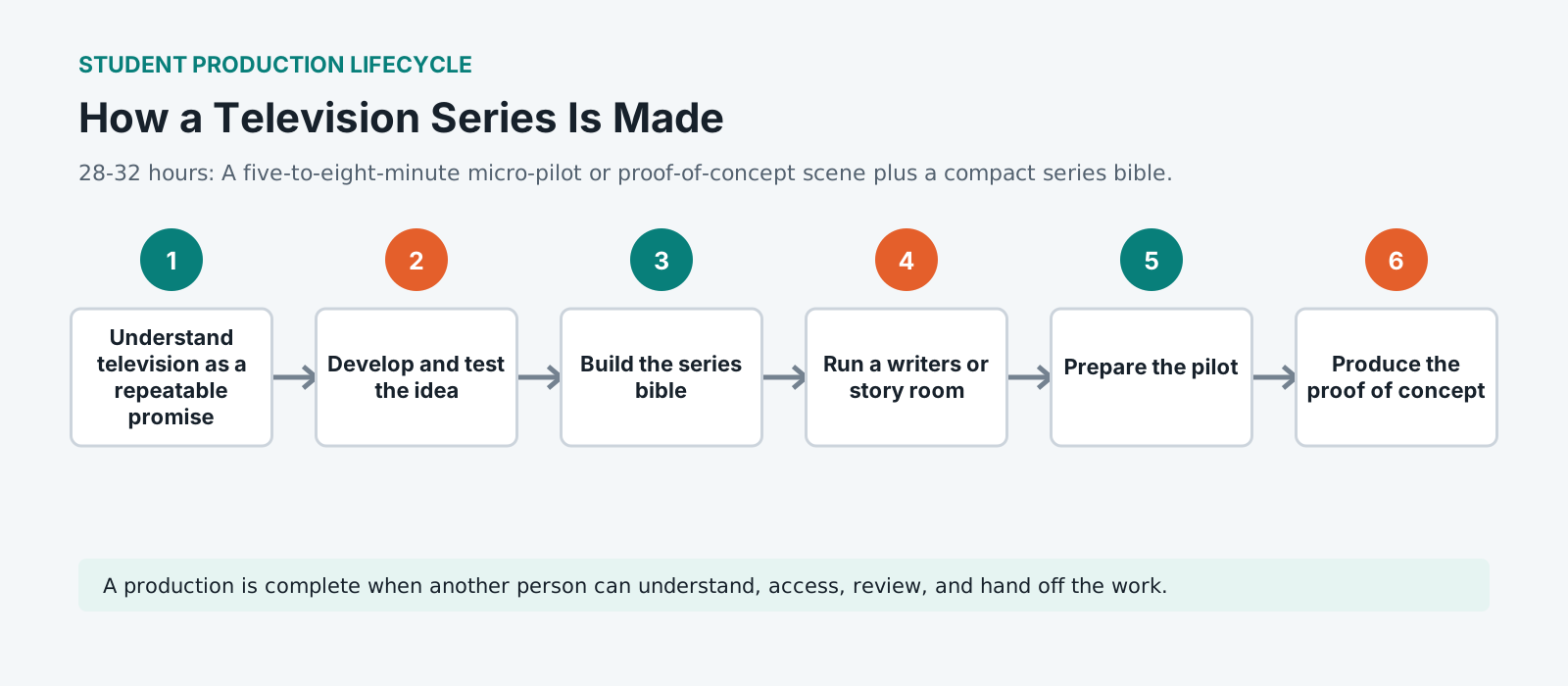
How a television series gets made, stage by stage
Television is a repeatable promise
A film has to work once. A series has to work again next week, made by people who are tired, to a length that does not move. Everything that follows is about repeatability: a format somebody else can produce, a tone that survives a change of director, and a production pattern that can absorb one bad week without losing the run.
Develop and test the idea
Test the premise before writing the scripts. Can you describe an episode that is not the pilot? If the only story you can tell is the one that sets everything up, you have a film. A series needs a situation that generates episodes, and the fastest way to find out is to sketch five of them and see which ones feel obligatory rather than optional.
Build the series bible
The bible exists so that people who were not in the room can make the show. Characters and what they want, the rules of the world, what an episode looks like, what the series will never do. That last one matters most: a boundary is the thing a writers' room needs when it is stuck at two in the morning.
Run a story room
A room is a machine for producing usable structure quickly. Its output is not dialogue. It is beats: what happens, in what order, and why the audience should still be there. Somebody has to hold the shape while everyone else breaks it, and the discipline is writing decisions down as they are made rather than relitigating them the next day.
Prepare the pilot
The pilot carries two jobs that pull against each other. It must be a good episode and it must teach the audience how to watch the rest. Prepare it as you would any shoot, then ask the extra question: does this show the pattern, or only the exception that starts it?
Produce the proof of concept
Most series are commissioned on evidence rather than description. A proof of concept is a short piece of the real thing, made to the standard the series would hold, that answers the question a commissioner actually asks: can these people execute this every week? Scope it so you can finish it well rather than attempt it broadly.
Edit and finish the sample
Cut for pace before polish. A sample that runs long reads as indecision whatever the picture looks like. Then finish it properly: intelligible dialogue, a consistent grade, captions, and a master that meets the delivery specification, because a sample that fails technical review says something about the production as well as the file.
Package, present and evaluate
Packaging is the difference between an idea and a proposal. What it is, who it is for, why now, what a season looks like, what the sample proves. Afterwards, evaluate honestly: what the sample demonstrated, what it did not, and what the next attempt should do differently.
Standardized practice pack
Television classroom pack
fictional series brief, research pack, format examples, contributor scenarios, script/treatment, production reports, rushes, graphics, music alternatives, continuity faults, caption fixtures Institution distributes large video and audio media through its licensed storage or learning system.
Rights and media boundary: the generated coursework defines required fixtures and evidence. Large media should be institution-distributed with rights, consent, checksum, and retention records.
Portfolio assessment
Capstone: Micro-pilot and series bible
Build a repeatable series idea and produce one feasible pilot sample that demonstrates audience, format, craft, access, and delivery decisions.
Submit
- One-page pitch and research log
- Compact series bible
- Episode outline and script or treatment
- Production book and role record
- Five-to-eight-minute pilot sample
- Captions/transcript, QC report, metadata, and reflection
Constraints
- The series concept must be repeatable beyond one episode.
- The pilot must be achievable in school time with the chosen equipment tier.
- Use a private classroom screening unless publication has been separately approved.
| Criterion | Weight | Strong evidence | Revision needed |
|---|---|---|---|
| Audience, story, and editorial judgment | 20 | Clear purpose, appropriate choices, evidence-led revisions | Purpose or audience is unclear or unsupported |
| Planning, communication, and teamwork | 15 | Roles, schedule, handoffs, and contribution are visible | Work depends on undocumented individual effort |
| Creative and technical craft | 20 | Intentional image, sound, writing, editing, design, or operation | Choices are accidental or technically uncontrolled |
| Reliability, organization, and problem solving | 15 | Files, tests, recovery, revision, and delivery are dependable | The project cannot be opened, checked, or recovered |
| Ethics, rights, safety, and accessibility | 15 | People and audiences are respected throughout the workflow | Permissions, safety, access, or representation are incomplete |
| Delivery, reflection, and career evidence | 15 | Final package, QC, walkthrough, and next-skill plan are clear | The student cannot explain or hand off the work |
Career connection
See where these roles lead
Connect this work to development producer and commissioning editor and one adjacent role. Ask students what evidence would let a supervisor trust the work. Connect this work to researcher and development producer and one adjacent role. Ask students what evidence would let a supervisor trust the work. Connect this work to series producer and story editor and one adjacent role. Ask students what evidence would let a supervisor trust the work.
Explore media careersSource base
References and review
- W3C: Making Audio and Video Media Accessible
- UNESCO: Media and Information Literacy
- UNESCO: AI Competency Framework for Teachers
- Creative Commons educator licensing portal
- ScreenSkills career maps
- BLS: Producers and Directors
- ScreenSkills: Film and TV career maps
Curriculum reviewed 2026-07-13. Local school policy and current platform behavior must be checked before delivery.
Vocabulary
Series bible The reference document that lets people who were not in the development room make the show: characters and motivations, the rules of the world, the shape of an episode, and the things the series will never do.
Story room A group of writers working together to produce episode structure rather than dialogue. Its output is beats, meaning what happens and in what order, agreed and written down so decisions are not relitigated the following day.
Proof of concept A short piece of the real programme, made to the standard the series would hold, produced to demonstrate that a team can execute the idea repeatedly. Commissioners rely on it more than on written description.
Format The repeatable pattern of a series: its length, its structure, and what an audience is promised each time. A format is what allows a different director to make an episode that still belongs to the same show.