Shared high-school orientation / 4 hours
Production Readiness: Make Media Safely and Hand It Off
A shared orientation for high-school students covering audience, consent, rights, safety, accessibility, roles, files, versions, and handoff before a production begins.
What students will be able to do
- Translate an idea into an audience promise and observable success criteria.
- Identify consent, privacy, rights, safety, accessibility, and publication decisions before recording.
- Create a folder, naming, version, backup, and handoff system another student can navigate.
- Participate in a respectful crew with a clear role, communication path, and stop-work authority.
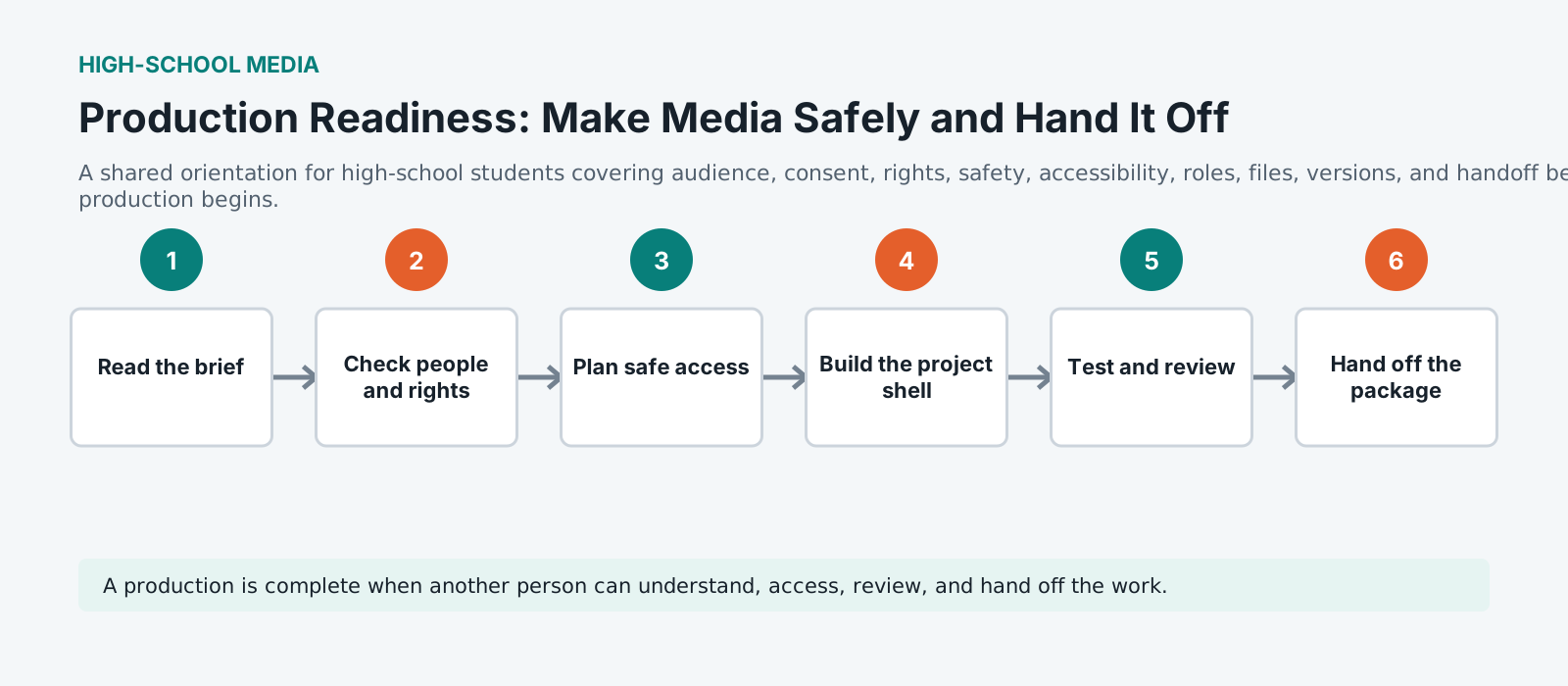
Complete the orientation workflow
- 1
Read the brief. Create one visible piece of evidence before moving on.
- 2
Check people and rights. Create one visible piece of evidence before moving on.
- 3
Plan safe access. Create one visible piece of evidence before moving on.
- 4
Build the project shell. Create one visible piece of evidence before moving on.
- 5
Test and review. Create one visible piece of evidence before moving on.
- 6
Hand off the package. Create one visible piece of evidence before moving on.
Completion evidence
Build a reusable project shell
Submit a folder structure, delivery checklist, source inventory, first versioned project name, decision-log template, QC template, and archive-manifest template. Reuse the shell in every high-school production course.
Why readiness comes before the camera
Almost every production problem that ruins a student project was created before anybody pressed record. Somebody appears on camera who never agreed to it. A location turns out to need permission nobody asked for. Two people believed they were making different things. None of these are fixable in the edit, and all of them are avoidable in twenty minutes of conversation beforehand.
Start from the audience promise, which is a single sentence saying who this is for and what they will get. Writing it down forces the disagreements out into the open while they are still cheap. A group that cannot agree on the sentence does not yet have a project, and discovering that at the planning stage is a good outcome rather than a setback.
Success criteria have to be observable. Make it look professional is not a criterion, because two people will judge it differently and neither can say when it has been met. The audio is intelligible on phone speakers is a criterion, because anybody can check it. Every vague goal you convert into an observable one removes an argument you would otherwise have at the end.
Consent is a decision made before recording, never after. Anybody appearing recognisably in your work needs to know what it is for, where it will be shown, and for how long. Somebody happy to be filmed for a class exercise has not agreed to appear on a public channel, and treating those as the same permission is the single most common mistake in student work.
Rights apply to everything you did not make yourself. Music, images, fonts, clips and sound effects all belong to somebody, and finding something online is not permission to use it. Working from material that is genuinely free to use, and recording where it came from at the moment you download it, takes seconds and prevents a takedown after publication.
Safety planning is not paperwork for its own sake. Knowing who is responsible, where the exits are, what the risky part of the day is, and who has the authority to stop work is what turns an accident into a near miss. Everybody on a crew should know they can stop the shoot, and knowing it in advance is what makes them willing to use it.
Accessibility decisions are cheapest at the start. Captions, readable text sizes and adequate contrast are straightforward when planned and awkward when retrofitted, and a video published without them excludes part of its audience entirely. Deciding at the outset that captions are part of finished rather than a bonus removes the question later.
Roles exist so that decisions have an owner. On a crew where everybody is vaguely responsible for sound, nobody is checking the levels, and the problem surfaces in the edit when it is too late to fix. Assigning a named person to each area, and rotating those roles between projects, is what turns a group into a crew and gives every student experience of each job.
Handoff is the test of everything above. If another person can open your folder and understand what is source material, what is in progress and what is final, without asking you, then your naming, versioning and documentation work. If they cannot, then the project exists only in your head, and that is a problem the moment you are ill, busy or finished with the course.
Vocabulary
Audience promise. One sentence stating who a piece of work is for and what they will get from it. Written before production so disagreements surface while they are still cheap to resolve, and used afterwards to judge whether the work succeeded.
Consent. Agreement from somebody appearing in a recording, covering what it is for and where it will be shown. Obtained before recording rather than after, because a person declining afterwards leaves you with material you cannot use.
Stop-work authority. The right of anybody on a crew to halt production if something looks unsafe, regardless of their role or seniority. Stated in advance, because people only use it when they know for certain they have it.
Handoff. Passing a project to somebody else so they can continue it without your explanation. The practical test of whether your file naming, versions and notes are actually organised or only familiar to you.