By the end of this module
- Create a harmonic progression with controlled tension and release.
- Write a bass part that clarifies harmony and groove.
- Develop a memorable motif into a complete melodic phrase.
Core knowledge
Principles before controls
Harmony is perceived movement
Chord labels matter less than how common tones, bass motion, dissonance, register, and timing create expectation.
Voice leading connects events
Small purposeful motion between chord tones often creates stronger continuity than repeatedly jumping to root-position shapes.
Melody needs identity and direction
A motif combines interval, rhythm, contour, and articulation. Development changes some properties while preserving others.
Bass belongs to rhythm and harmony
Its register, duration, attack, and relationship to kick define both chord foundation and physical groove.
Guided build / approximately 90-120 minutes
Build it in the application
- 1
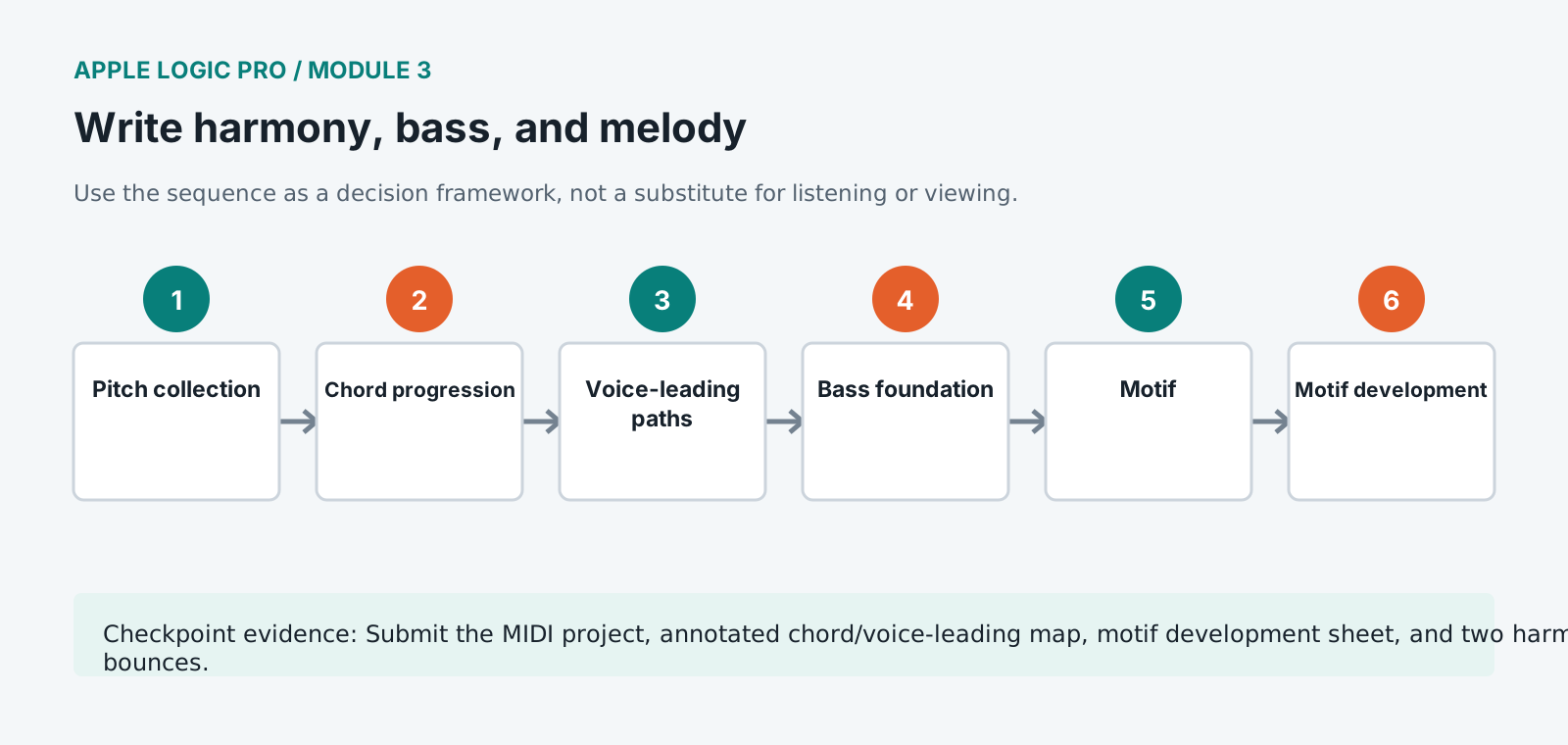
Choose a scale or pitch collection that supports the brief and place its notes in a reference MIDI region.
- 2
Create a four- or eight-chord progression using triads or simple extensions, then label stable and tense moments.
- 3
Edit inversions and note spacing so individual voices move purposefully and avoid unnecessary register jumps.
- 4
Write a bass line that sometimes states roots and sometimes connects them rhythmically or stepwise.
- 5
Create a two-bar motif with a distinctive rhythm and contour using a lead instrument.
- 6
Develop the motif through sequence, fragmentation, inversion, extension, rhythmic displacement, or changed ending.
- 7
Use non-chord tones intentionally as passing, neighboring, suspension, or color notes and audition their resolution.
- 8
Test the material with a contrasting sound to ensure the musical idea survives preset changes.
- 9
Bounce harmony/bass and full-motif versions and annotate tension, arrival, and formal function.
Independent challenge / 45-60 minutes
Prove the principle
Write two harmonizations for the same motif: one stable and one uncertain. Change voice leading and bass behavior before changing the sound palette.
Portfolio checkpoint
Evidence to retain
Submit the MIDI project, annotated chord/voice-leading map, motif development sheet, and two harmonized bounces.
Store this evidence in 01_ADMIN/checkpoints/module-3 and include it in the final decision log.
Failure modes
Diagnose before retrying
Chord changes sound disconnected
Reduce voice movement, sustain common tones, reconsider bass leaps, and align harmonic rhythm with phrase structure.
Melody follows every chord too literally
Preserve motif identity across harmony and use target notes rather than arpeggiating each chord.
The bass masks harmony
Simplify duration or register, coordinate with kick, and leave space for chord attacks.
Working vocabulary
Terms you must be able to explain
- voice leading
- The motion of individual notes from one harmony to the next.
- motif
- A short identifiable musical idea with rhythmic and pitch characteristics.
- harmonic rhythm
- The rate and placement of harmonic changes.
- non-chord tone
- A note outside the current chord used for motion, tension, or color.
Primary sources
Verify current behavior
Lesson reviewed 2026-07-13. Verify menus and shortcuts against the lab release.
Failure in practice
Where this goes wrong
Bass and melody fail together more often than separately. A bass line moving in the same rhythm as the melody leaves the middle of the arrangement empty and the two competing, while a bass holding while the melody moves gives each somewhere to live. Write them against each other rather than one after the other.
Voice leading is what makes a chord sequence sound intentional. Moving every note of a chord to the nearest note of the next produces smooth motion, and jumping whole chords around the keyboard produces a sequence that is correct on paper and lumpy to listen to. This matters most on sustained instruments.
Sing the melody without the accompaniment. A line that holds up unaccompanied is a melody, and one that collapses is a texture depending on its harmony, which is a different and more fragile thing.