By the end of this module
- Create a complete beginning-to-end arrangement.
- Use register and density to clarify musical roles.
- Build transitions that prepare rather than merely decorate formal change.
Core knowledge
Principles before controls
Form is managed expectation
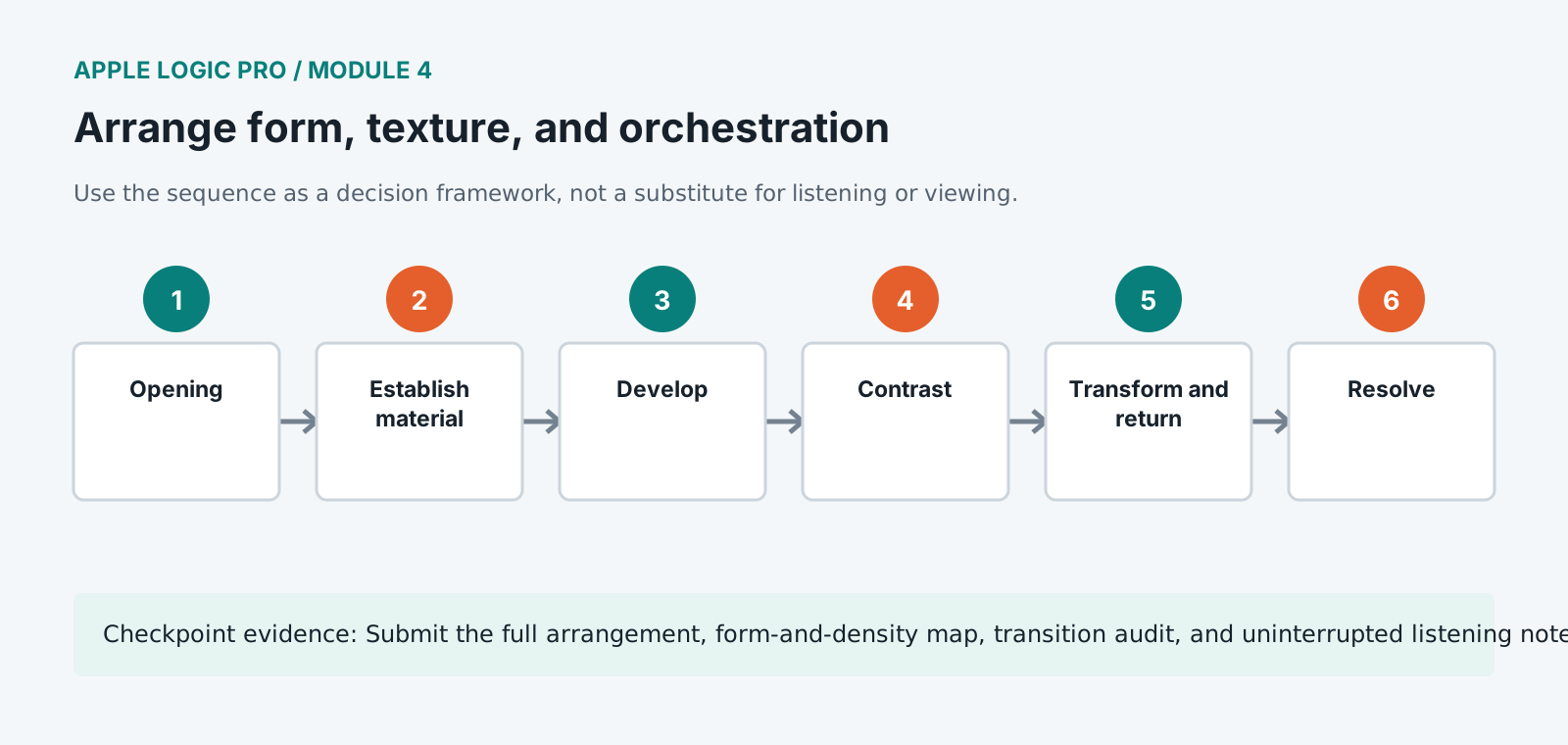
Sections establish, develop, contrast, interrupt, return, and resolve material over time.
Texture is a distribution of attention
Foreground, support, pulse, bass, environment, and transition roles should not all compete in the same register and rhythm.
Orchestration is change over time
Instrument choice matters, but entrances, exits, doubling, register, articulation, and density create the larger arc.
Transitions need causality
A fill, riser, pause, harmonic pivot, automation move, or pickup should prepare a specific arrival.
Guided build / approximately 90-120 minutes
Build it in the application
- 1
Duplicate the project and convert provisional arrangement markers into exact section boundaries.
- 2
Place the strongest complete statement of the core idea, then design what the listener must understand before it arrives.
- 3
Build the opening by introducing only enough information to establish world, pulse, or question.
- 4
Develop the first section through variation rather than adding every layer immediately.
- 5
Create a contrasting section by changing at least two dimensions among harmony, rhythm, register, texture, palette, and density.
- 6
Return to recognizable material with one meaningful transformation that demonstrates progression.
- 7
Audit every octave for competing sustained material and redistribute register, articulation, or rhythm.
- 8
Design each transition backward from its arrival and remove effects that do not clarify the formal event.
- 9
Listen from beginning to end without stopping, mark attention drops or premature peaks, and revise proportions.
- 10
Repeat the form review at low playback level to confirm that musical roles and section changes remain legible without loudness cues.
Independent challenge / 45-60 minutes
Prove the principle
Arrange the same core material into a 60-second concise version and a 150-second developed version. Identify what the longer form earns.
Portfolio checkpoint
Evidence to retain
Submit the full arrangement, form-and-density map, transition audit, and uninterrupted listening notes.
Store this evidence in 01_ADMIN/checkpoints/module-4 and include it in the final decision log.
Failure modes
Diagnose before retrying
The piece sounds like repeated loops
Change internal events, phrase endings, texture, harmony, and transition logic rather than only muting whole tracks.
The climax arrives too early
Control register, density, loudness, harmonic tension, and strongest timbres across the whole arc.
Transitions feel like effects pasted on top
Connect them to existing rhythmic, melodic, or timbral material and the exact next-section entrance.
Working vocabulary
Terms you must be able to explain
- form
- The large-scale organization and recurrence of musical sections.
- texture
- How simultaneous musical roles and layers relate.
- orchestration
- The assignment and evolution of material across instruments, timbres, registers, and articulations.
- density
- The amount and activity of musical information at a given moment.
Primary sources
Verify current behavior
Lesson reviewed 2026-07-13. Verify menus and shortcuts against the lab release.
Failure in practice
Where this goes wrong
Arrangement problems are usually subtraction problems. A section that feels cluttered rarely needs a new part to fix it, and nearly always needs an existing part to stop. Muting things one at a time until the section works is faster than adding, and the result is almost always simpler than the version you started with.
Register is the most underused arranging tool. Two instruments in the same octave compete no matter how they are mixed, and moving one an octave apart resolves it without touching a single equaliser. Check the spread of your parts across the range before assuming a balance problem is a mix problem.
Mute every part except two and listen to each pair. Arrangement problems live in relationships rather than in individual parts, and hearing them two at a time locates the conflict faster than hearing all of them.