By the end of this module
- Automate position with musically meaningful timing.
- Create section contrast using density, width, depth, and height.
- Preserve focal stability while secondary elements move.
Core knowledge
Principles before controls
Motion should follow musical causality
Movement can reveal an entrance, echo a gesture, carry a transition, or change perspective. Random continuous motion weakens meaning.
Depth is level, spectrum, directness, and space
Panner position alone does not create convincing near/far relationships. Combine position with arrangement and acoustic cues.
Automation density affects readability
Fewer, shaped moves are easier to perceive and translate than many competing trajectories.
Section contrast can be spatial
Verse, pre-chorus, chorus, bridge, and outro can change width, envelopment, height, or listener perspective while maintaining identity.
Guided build / approximately 90-120 minutes
Build it in the application
- 1
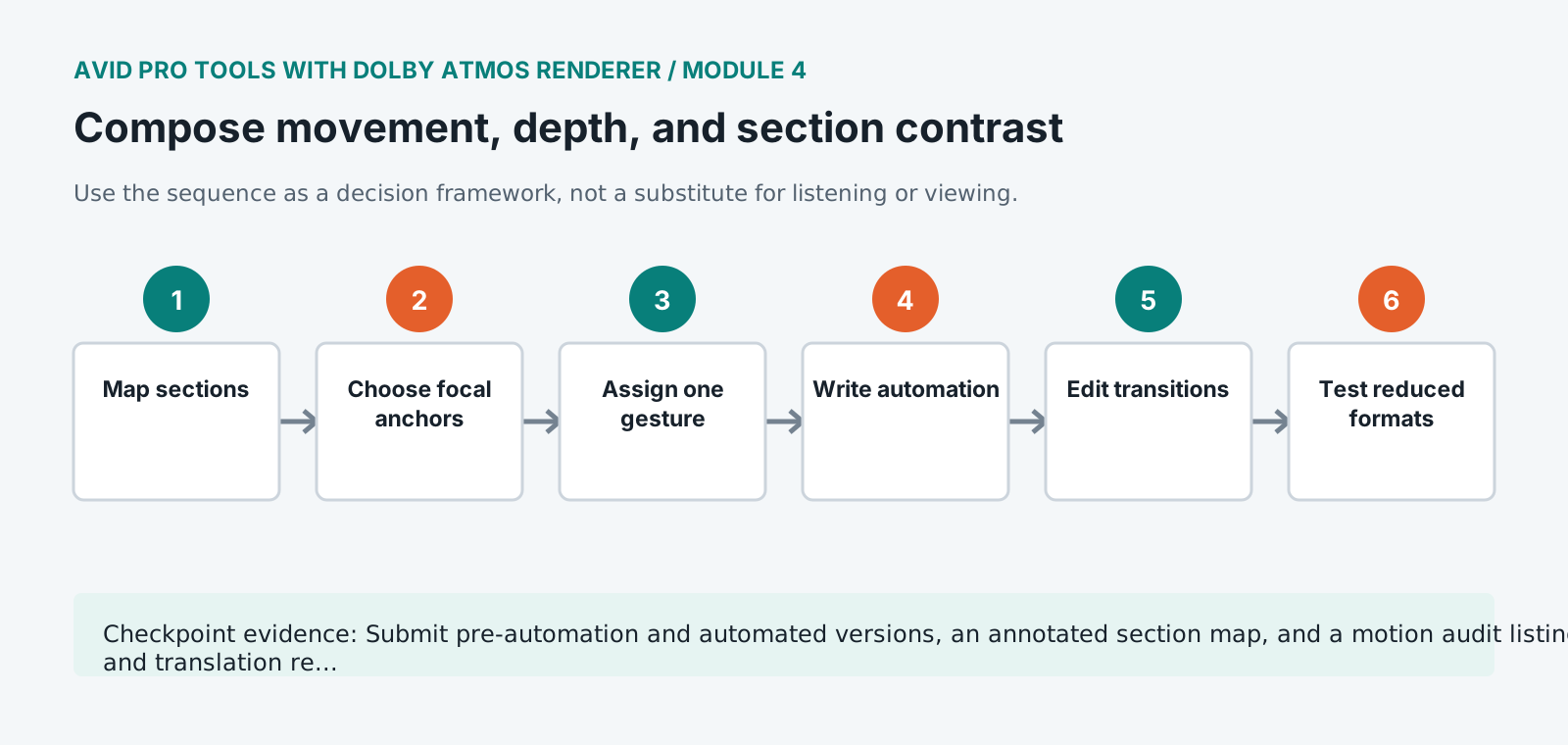
Map song sections and mark every proposed spatial change before writing automation.
- 2
Keep lead vocal and rhythmic anchors stable through the first pass while choosing two secondary elements for motion.
- 3
Write one gesture using manual panning and one using shaped pan automation, then compare precision and musical feel.
- 4
Use width and divergence controls to balance localization against envelopment.
- 5
Create a depth transition by coordinating level, spectral detail, ambience, and position rather than panning alone.
- 6
Expand the chorus with selected surround and height contributions while preserving a recognizable frontal mix.
- 7
Reduce or redirect space in the bridge to create contrast without simply making it quieter.
- 8
Read and edit pan automation for smooth entrances, complete tails, and no unintended jumps at clip or section boundaries.
- 9
Audition every move in binaural, stereo, and mono immediately after approving it in 7.1.4.
Independent challenge / 45-60 minutes
Prove the principle
Design one movement that communicates a lyric or production gesture and one section transition using only spatial contrast. Remove any automation that does not survive blind review.
Portfolio checkpoint
Evidence to retain
Submit pre-automation and automated versions, an annotated section map, and a motion audit listing purpose and translation result.
Store this evidence in 01_ADMIN/checkpoints/module-4 and include it in the final decision log.
Failure modes
Diagnose before retrying
Object jumps at a boundary
Inspect automation breakpoints, coalescing, clip boundaries, suspended parameters, and the value immediately before the transition.
Movement is obvious on speakers but absent binaurally
Review path, binaural mode, trajectory speed, spectral content, masking, and whether the cue relies mainly on vertical localization.
The chorus is bigger but less focused
Restore anchors, reduce simultaneous motion, and separate width/envelopment from focal level.
Working vocabulary
Terms you must be able to explain
- divergence
- A control distributing an object beyond a precise point location.
- trajectory
- The path of a moving sound over time.
- envelopment
- The perception of being surrounded by a sound field.
- spatial contrast
- A meaningful difference in placement, width, depth, height, or motion between sections.
Primary sources
Verify current behavior
Lesson reviewed 2026-07-13. Verify menus and shortcuts against the lab release.
Failure in practice
Where this goes wrong
Movement is most effective when it is rare. Continuous panning becomes wallpaper within a minute and makes a mix tiring, while one element moving at one moment is noticed. Deciding in advance which two or three moments carry movement is more effective than automating everything and reducing later.
Height is a placement rather than an effect. Material lifted overhead because the channels exist tends to sound detached from the music, and the height layer works best carrying things that genuinely belong above a listener, such as reflections, ambience and the tail of a reverb.
Count the moments of movement in the whole piece. If the number is higher than you can recall unprompted, there is more motion than a listener will register as intentional.