By the end of this module
- Run repeatable multi-format listening comparisons.
- Identify renderer, arrangement, and processing causes of translation failures.
- Document loudness and peak behavior for the master and re-renders.
Core knowledge
Principles before controls
Translation is not identical playback
The goal is preserved hierarchy, intention, and acceptable balance, not the same localization on every device.
Binaural is a render, not a room substitute
Use it as an essential consumer perspective while retaining speaker review for localization, envelopment, and low-frequency behavior.
Meter the relevant output
Measure the ADM/re-render path required by the brief and state exactly which render, duration, and meter settings produced the result.
Fatigue is a quality fault
Persistent movement, extreme width, bright overhead material, and dense ambience can reduce comfort even when meters pass.
Guided build / approximately 90-120 minutes
Build it in the application
- 1
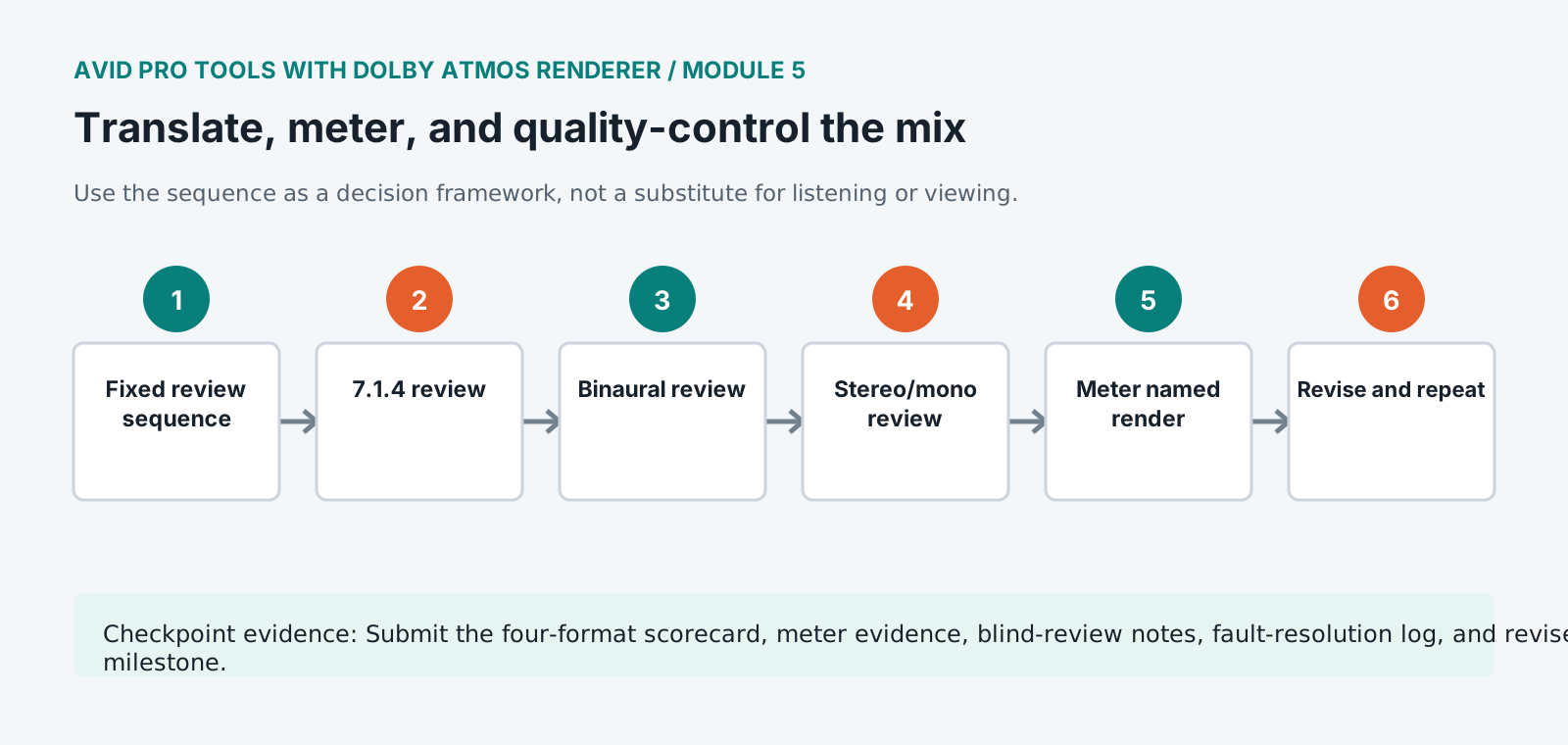
Create a fixed review sequence containing intro, first verse, chorus, bridge, final chorus, and tail.
- 2
Set a repeatable monitor level and compare 7.1.4, binaural, stereo, and mono without changing mix controls.
- 3
Score focal clarity, lyric intelligibility, low-end stability, ambience, motion, transitions, and fatigue for each format.
- 4
Inspect every reduced-format failure at its source path and determine whether routing, phase, metadata, masking, or arrangement is responsible.
- 5
Measure the required full-duration re-render for integrated loudness and maximum true peak, resetting history before each pass.
- 6
Check beginning, section boundaries, automation returns, mutes, solos, object activity, and final tails for discontinuities.
- 7
Run a low-level binaural listen and a moderate-level speaker listen to expose different balance and fatigue problems.
- 8
Invite a blind reviewer to describe the musical focus and major spatial changes without seeing the session.
- 9
Revise only documented problems and rerun the complete test matrix.
Independent challenge / 45-60 minutes
Prove the principle
Resolve three supplied translation faults without flattening the Atmos intent: disappearing element, over-bright binaural height, and unstable mono low end.
Portfolio checkpoint
Evidence to retain
Submit the four-format scorecard, meter evidence, blind-review notes, fault-resolution log, and revised mix milestone.
Store this evidence in 01_ADMIN/checkpoints/module-5 and include it in the final decision log.
Failure modes
Diagnose before retrying
Integrated values differ unexpectedly
Confirm render selection, complete duration, meter reset, trim/downmix settings, and whether monitor control alters the measured path.
Mono loses a central element
Inspect polarity, stereo widening, decorrelation, object/re-render assignment, and shared processing.
Binaural playback is tiring
Reduce persistent near-ear movement or brightness, revisit binaural modes, and create calmer spatial rest points.
Working vocabulary
Terms you must be able to explain
- downmix
- A reduced-channel representation derived from a larger mix.
- binaural render
- A two-channel headphone representation using spatial filtering.
- translation matrix
- A structured comparison of mix behavior across playback formats.
- fatigue
- Reduced listening comfort or attention caused by persistent sonic demands.
Primary sources
Verify current behavior
Lesson reviewed 2026-07-13. Verify menus and shortcuts against the lab release.
Failure in practice
Where this goes wrong
Most listeners will hear the binaural or downmixed version rather than the full layout, so checking those is not a formality. A mix relying on separation between positions can collapse into congestion once folded down, and finding that at the delivery stage means remixing rather than adjusting.
Metering an immersive mix measures the render rather than the session. Levels that look correct on individual tracks say nothing about what the renderer produces, and the loudness figure a platform assesses is taken from the deliverable. Meter the output, at full length.
Listen to the binaural render on ordinary headphones, which is how most of the audience will hear it. A mix judged only in the room is judged in conditions almost nobody shares.
Check the mix at a low listening level as well as a loud one. Spatial impressions change with volume, and a mix that only holds together loud is one most listeners will never hear as intended.