At a Glance
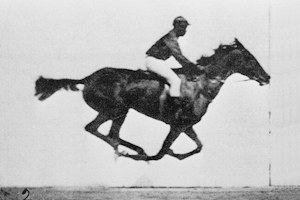
Eadweard Muybridge (1830-1904) used a battery of cameras with trip-wire shutters to photograph successive phases of a galloping horse in 1878, proving that all four hooves leave the ground. The result mattered far beyond the wager: it demonstrated that continuous movement could be sampled into discrete instants, which is the founding premise of cinema, television and every video codec since.
- Lived: 1830-1904, Britain, worked in the United States
- Anchor year: 1878, the galloping horse sequence
- Strand: canon
Career
The problem as it stood
Photography in the 1870s needed exposures far too long to freeze fast movement, and the human eye cannot resolve the phases of a gallop. Whether a horse ever has all four feet off the ground was genuinely unsettled, and painters had rendered it wrongly for centuries.
What he actually did
Financed by Leland Stanford, Muybridge set a line of cameras along a track, each triggered by a thread broken by the passing horse, and developed shutter and emulsion techniques fast enough to freeze the motion. The 1878 sequence showed unambiguously that all four hooves leave the ground, at a point in the stride nobody had painted.
How it worked
Each camera captures one instant. Laid out in order they form a sampled record of a continuous movement, and played back fast enough. Muybridge built the zoopraxiscope to do exactly that, they reconstruct it. Sampling a continuous signal finely enough to reconstruct it is the same principle Nyquist would later formalise for sound.
What it made possible
Muybridge's work directly influenced Marey, Edison's laboratory and effectively everyone working toward motion pictures. His later human and animal locomotion studies remain in print as reference for animators, and the sampling insight underlies all moving-image media.
What happened to him
He lectured internationally with the zoopraxiscope and published extensive locomotion studies. In 1874 he shot and killed his wife's lover and was acquitted by a jury on the grounds of justifiable homicide: a fact usually left out of accounts of his technical work. He returned to England and died in 1904.
Where the credit landed
Muybridge is well credited, and the horse sequence is one of the few genuinely famous images in this history. What tends to get lost is that the important thing was not the answer about the hooves but the method: deliberately sampling continuous motion at intervals fine enough to reconstruct it. That is the idea the entire chain rests on.
Known For
- The horse settled a bet. The method founded a medium.
- Sampling motion finely enough to reconstruct it is the same idea Nyquist later formalised for sound.
- His locomotion studies are still used as animation reference.
Knowledge Base
What You'll Learn
Everything downstream in this corpus assumes that continuous reality can be sampled. This is where that was demonstrated.
Sampling, before anyone called it that
A gallop is continuous. A photograph is an instant. Muybridge showed that a sufficiently dense series of instants carries enough information to reconstruct the movement convincingly. Too few samples and the motion breaks up, which is why frame rate is a real constraint and not a convention, and why undersampled motion produces the wagon-wheel effect familiar from film.
Where This Fits
Muybridge's cameras broke motion into frames at the capture end of the chain traced in A History of Broadcast Technology.
FAQ
Q: What did the galloping horse experiment prove?
A: That all four of a horse's hooves leave the ground simultaneously during a gallop, at a moment in the stride that artists had not depicted. More importantly it demonstrated that continuous motion could be sampled into discrete frames and reconstructed.
Q: Did Muybridge invent cinema?
A: No. He established the principle of sampling motion photographically and built the zoopraxiscope to replay it. Cameras and projectors capable of recording and showing continuous scenes came later, from Marey, Le Prince, Dickson, the Lumières and others.
Sources
The motion photography patent was checked against the record. Checked 20 August 2026.
- US Patent 279,878, Method of and Apparatus for Photographing Changing or Moving Objects. Filed 31 August 1881, renewed in 1883 and granted 19 June 1883, under the name Edward J. Muybridge. It describes multiple cameras with electrically controlled shutters synchronised by a motor driven circuit.
Translate this page
- Español
- 简体中文
- हिन्दी
- العربية
- Português
- Français
- Deutsch
- 日本語
- Русский
- Bahasa Indonesia
- 한국어
- Italiano
- Türkçe
- Tiếng Việt
- Polski
- Nederlands
Machine translation provided by Google Translate, on Google’s servers. We do not check these translations and they will get technical terms wrong. The English page is the authoritative one. Following a link sends this page’s address to Google. Your browser may also offer to translate this page itself, which keeps the request on your device.