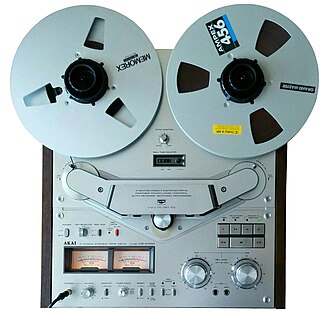
 Akai GX-635D reel-to-reel tape recorder, c. 1978, illustrative of the format, not Mullin's own machineArchival scan, shown at its original size. Image credit & licence
At a Glance
John T. "Jack" Mullin (1913-1999) was a US Army Signal Corps officer who, at the end of the war, acquired two AEG Magnetophon recorders and a stock of tape, shipped them home in parts, rebuilt them with improved electronics, and demonstrated them in 1946-47. Bing Crosby used the result to pre-record his radio show, and backed Ampex to build American machines.
- Lived: 1913-1999, United States
- Anchor year: 1946, the American demonstrations
- Strand: overlooked, transfer is not invention, but it is not nothing
Career
The problem as it stood
American broadcasting was live or cut to disc, with the quality and inflexibility that implied. Networks actively forbade recorded programming on quality grounds. The German technology was known to exist but not understood.
What he actually did
Mullin found Magnetophons at a radio station near Frankfurt, obtained them, and had them shipped home in over thirty parcels. He rebuilt them with improved electronics and demonstrated them to audio engineers and then to the film and radio industries.
How it worked
The machines already had AC bias, which was the crucial thing the Americans lacked. Mullin's contribution was reconstruction, improvement and. Decisively, demonstration to the people who could act on it. Crosby, who hated live broadcasting, immediately grasped what it meant.
What it made possible
Recorded network radio in America, and therefore the whole practice of assembling a broadcast from takes. Crosby's investment in Ampex produced the Model 200, and Ampex went on to solve videotape a decade later.
What happened to him
He worked with Crosby's electronics enterprise and later at 3M, remaining a central figure in magnetic recording and an assiduous historian of it.
Where the credit landed
Mullin invented nothing in the strict sense and his role is genuinely important, which makes him a useful test of what this corpus is for. Technology transfer, recognising what matters in someone else's work, reconstructing it, and putting it in front of people who can act: is a real contribution that invention-shaped histories have no category for. Crosby's part is likewise real and is routinely inflated into having invented tape, which he did not.
Known For
- The German machines already had AC bias: that was the crucial missing piece in America.
- Crosby backed Ampex. Ampex then solved videotape in 1956.
- Recognising and transferring someone else's advance is a real contribution with no category.
Knowledge Base
What You'll Learn
Not every consequential act in this history is an invention.
Why American radio resisted recording
The networks had built their authority on live performance and regarded transcription discs as inferior, which they were. Crosby wanted to pre-record so he could work on his own schedule and edit, and had been in conflict with NBC about it. Tape resolved the quality objection completely, and once one major star demonstrated that a recorded show could be indistinguishable, the policy collapsed across the industry.
Where This Fits
Mullin brought tape recording to American broadcasting, a recording link covered in A History of Broadcast Technology.
FAQ
Q: What did Jack Mullin actually do?
A: He acquired two German Magnetophon tape recorders at the end of the war, shipped them to America in parts, rebuilt them with improved electronics, and demonstrated broadcast-quality tape to the American radio and film industries in 1946-47.
Q: What was Bing Crosby's role?
A: He adopted tape to pre-record his radio show and invested in Ampex, which built American machines. He did not invent tape recording, contrary to a persistent claim.
Sources
No document is cited here, though one near miss is worth recording. Checked 20 August 2026.
A 1965 paper in IEEE Transactions on Audio, volume AU-13, issue 2, pages 31 to 35, titled Advanced tape mastering system, electronic features, is credited to J. Mullin. The record gives an initial only, so the identification is probable rather than certain and it is not cited above. The 1946 demonstrations the anchor year refers to were events rather than publications. The Pavek Museum holds Mullin's collection, including the Magnetophon machines he brought back.
Translate this page
- Español
- 简体中文
- हिन्दी
- العربية
- Português
- Français
- Deutsch
- 日本語
- Русский
- Bahasa Indonesia
- 한국어
- Italiano
- Türkçe
- Tiếng Việt
- Polski
- Nederlands
Machine translation provided by Google Translate, on Google’s servers. We do not check these translations and they will get technical terms wrong. The English page is the authoritative one. Following a link sends this page’s address to Google. Your browser may also offer to translate this page itself, which keeps the request on your device.