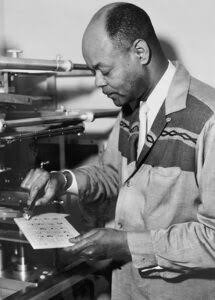
 Archival scan, shown at its original size. Image credit & licence
At a Glance
Otis Boykin (1920-1982) developed precision wire resistors that maintained their specified resistance despite mechanical shock, vibration and temperature change, and could be manufactured cheaply and consistently. They went into televisions, computers, military electronics and the control unit of the first implantable cardiac pacemakers. He held around two dozen patents.
- Lived: 1920-1982, United States
- Anchor year: 1959, the precision wire resistor patent
- Strand: overlooked, component engineering is invisible by design
Career
The problem as it stood
A resistor whose value drifts with temperature or shifts when knocked will detune a circuit. In a television that means picture and sound faults. In a missile or a pacemaker it means failure. Mid-century components were also expensive to make to tight tolerance, and cost per unit matters enormously when a receiver contains hundreds of them.
What he actually did
Boykin developed resistor designs, wire precision resistors, and later an electrical resistance capacitor, that held tolerance under adverse conditions while being cheaper and more reliable to manufacture than what preceded them.
How it worked
The gains came from materials and construction: how the resistive wire is wound and supported, and how the assembly is protected, so that thermal expansion and mechanical stress do not change the effective resistance. It is unglamorous engineering whose payoff is that nothing happens: the circuit behaves the same on a cold morning as on a hot afternoon, and after being dropped.
What it made possible
More reliable consumer electronics at lower cost, which is a precondition for mass-market television. His components were used in military electronics and in the pacemaker, where component drift is not an inconvenience but a mortal risk.
What happened to him
Boykin worked as an independent consultant to manufacturers, continuing to develop electronic components until his death in 1982. He was a Black engineer building a career in an industry and era that made that exceptionally difficult.
Where the credit landed
Component engineers are structurally invisible: nobody buys a television for its resistors, and no history of broadcasting has a chapter on passive components. Boykin is included because the chain from camera to screen runs through hundreds of parts like his, and because Black engineers of his generation are underrepresented in the record for reasons that have nothing to do with the quality of their work.
Known For
- Reliability engineering is invisible when it succeeds, that is the job.
- A receiver contains hundreds of passive components. Their cost and drift decide whether mass-market TV is possible.
- His resistors were used in the first implantable pacemakers.
Knowledge Base
What You'll Learn
The chain from camera to screen is mostly made of parts nobody names.
Why component tolerance decides what a medium can be
Every tuned circuit in a receiver depends on components holding their values. If they drift, the set needs adjustment. If they need adjustment, it needs a technician. If it needs a technician, it is not a mass-market product. The path from laboratory television to a set in every home runs through component reliability as much as through any camera tube.
Where This Fits
Boykin's resistors held tolerance inside receivers, part of the display end of the chain followed in A History of Broadcast Technology.
FAQ
Q: What did Otis Boykin invent?
A: Precision wire resistors that hold their specified value under shock, vibration and temperature change while being cheap to manufacture, plus related components including an electrical resistance capacitor. He held around two dozen patents.
Q: Were his components used in pacemakers?
A: Yes, his resistors were used in the control unit of the first implantable cardiac pacemakers, an application where component drift would be life-threatening.
Sources
Boykin's patents were checked against the records, which show precisely what he did and did not patent. Checked 20 August 2026.
- US Patent 2,891,227, Wire Type Precision Resistor. Filed 6 July 1954 and granted 16 June 1959, which is the patent the anchor year above refers to.
- US Patent 2,972,726, Electrical Resistor. Filed 27 February 1956 and granted 21 February 1961. Both patents are for resistors. Neither is for a pacemaker, which is the claim frequently attached to his name.
Translate this page
- Español
- 简体中文
- हिन्दी
- العربية
- Português
- Français
- Deutsch
- 日本語
- Русский
- Bahasa Indonesia
- 한국어
- Italiano
- Türkçe
- Tiếng Việt
- Polski
- Nederlands
Machine translation provided by Google Translate, on Google’s servers. We do not check these translations and they will get technical terms wrong. The English page is the authoritative one. Following a link sends this page’s address to Google. Your browser may also offer to translate this page itself, which keeps the request on your device.