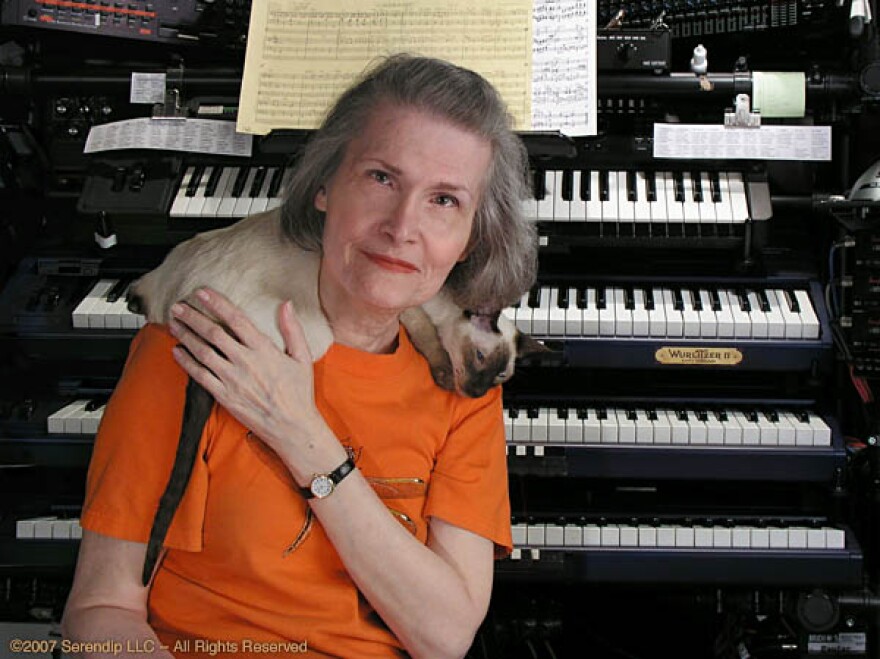
 Image credit & licence
At a Glance
Wendy Carlos (born 1939) recorded Switched-On Bach in 1968 using a Moog modular synthesiser, an instrument that could sound only one note at a time, by multitracking each line separately with painstaking tuning and articulation. It became one of the best-selling classical records ever made and established the synthesiser as a musical instrument rather than a laboratory curiosity. She also scored A Clockwork Orange, The Shining and Tron.
- Born 1939, United States
- Anchor year: 1968, Switched-On Bach
- Strand: canon
Career
The problem as it stood
The Moog modular was monophonic, drifted out of tune constantly, had no memory, and no established repertoire or technique. Most recordings made with it demonstrated novel sounds and little else, which is why it was heard as an effects device.
What she actually did
Carlos, who worked directly with Moog on refinements, built up Bach's counterpoint one line at a time on multitrack tape, retuning constantly and shaping each note's articulation by hand. The result is not a demonstration of a machine but a performance.
How it worked
Every voice of a fugue is a separate pass. Oscillators drifted with temperature, so tuning had to be checked continually. Envelopes were set per phrase to give phrasing. The achievement is musical judgement applied relentlessly to a machine that resisted at every stage.
What it made possible
The synthesiser as a mainstream instrument. Switched-On Bach sold in enormous quantities and made Moog a household name, and directly drove demand for the performable Minimoog. Her film scores then established electronic scoring in mainstream cinema.
What happened to her
She continued composing and recording, and did significant work on alternative tunings and on surround sound. She is a trans woman, and transitioned in the years after Switched-On Bach's success.
Where the credit landed
Carlos is properly credited and her contribution is often described as popularisation, which undersells it: she demonstrated what the instrument was forwhich the instrument itself did not establish. A note on this corpus's own practice: research for these pages found that her only freely licensed images are 1958 yearbook photographs predating her transition. Those are editorially indefensible regardless of licence and are not used here.
Known For
- The Moog was monophonic. Every voice of a fugue is a separate tape pass.
- Oscillators drifted constantly, so tuning was checked continually.
- She demonstrated the instrument's purpose, which is not the same as popularising it.
Knowledge Base
What You'll Learn
A new instrument is unusable until someone shows what it is for.
Why multitracking made a monophonic instrument polyphonic
The Moog modular could produce one pitch at a time. Multitrack tape lets each voice be recorded separately and combined, so a four-voice fugue is four passes. That is straightforward to describe and brutal to execute: every pass must match the others in tuning, tempo and articulation, on an instrument that drifts and has no memory of its settings. Polyphonic synthesisers, arriving with the Prophet-5 a decade later, removed the need entirely.
Where This Fits
Carlos showed what a synthesiser could do on record, and A History of Broadcast Technology follows recorded sound on to the listener.
FAQ
Q: How was Switched-On Bach recorded?
A: On a monophonic Moog modular synthesiser, one line at a time onto multitrack tape, with constant retuning and hand-shaped articulation for each note. A single fugue required as many passes as it has voices.
Q: Why did it matter so much?
A: It demonstrated that the synthesiser could make music rather than sound effects, sold in enormous numbers, and drove demand for performable instruments like the Minimoog.
Vocabulary
Multitrack recording. Recording parts separately onto different tracks and combining them later. Allows one performer to build an ensemble, and allows any part to be replaced without redoing the rest.
Monophonic. Able to sound only one note at a time. A constraint of early synthesisers, and the reason polyphonic music on them had to be assembled from many separate passes.
Overdub. Recording a new part while listening to previously recorded ones. The technique that turns a monophonic instrument into an orchestra, at the cost of every part being committed as it is played.
Timbre. The character of a sound distinguishing it from another at the same pitch and loudness. What synthesis lets a performer design directly rather than inheriting from a physical instrument.
Sources
No document is cited here, because the work is a recording. Checked 20 August 2026.
Switched-On Bach was released by Columbia Records in 1968, and the record itself is the primary evidence. The Library of Congress added it to the National Recording Registry, and the Library refused automated access from this machine, so nothing has been linked that was not read. The technical claim on this page, that the instrument was monophonic and every line was multitracked separately, is documented by the sleeve notes and by Carlos's own later accounts rather than by an independent record.
Translate this page
- Español
- 简体中文
- हिन्दी
- العربية
- Português
- Français
- Deutsch
- 日本語
- Русский
- Bahasa Indonesia
- 한국어
- Italiano
- Türkçe
- Tiếng Việt
- Polski
- Nederlands
Machine translation provided by Google Translate, on Google’s servers. We do not check these translations and they will get technical terms wrong. The English page is the authoritative one. Following a link sends this page’s address to Google. Your browser may also offer to translate this page itself, which keeps the request on your device.